

 By
·
4 minute read
By
·
4 minute read
Healthcare organizations must protect patient records, clinical applications, connected devices, cloud platforms, employee identities, and administrative systems without disrupting patient care. A compromised account or overlooked alert can quickly create operational, financial, and privacy risks.
AMDR for Healthcare combines autonomous threat investigation with human-led security oversight. Also known as Agentic Managed Detection and Response (AMDR), this model helps healthcare organizations investigate suspicious activity, contain routine threats, and escalate sensitive decisions to experienced analysts.
What Agentic MDR for Healthcare Looks Like
Agentic MDR for Healthcare uses AI agents to support the continuous cycle of monitoring, investigation, containment, and reporting. Instead of waiting for analysts to review every alert manually, AI agents collect evidence, connect related events, assess risk, and initiate approved response actions.
Common healthcare AMDR capabilities include:
- Monitoring identities, endpoints, networks, cloud platforms, and applications
- Investigating alerts across connected security tools
- Detecting suspicious account activity and unauthorized access
- Containing routine threats through approved response workflows
- Escalating patient-care-sensitive decisions to human analysts
- Documenting investigation findings and response actions
This approach supports continuous protection without requiring every healthcare organization to build and staff a complete internal security operations center.
Where Cyber Risk Builds in Healthcare
Healthcare environments combine clinical systems, administrative applications, cloud services, connected devices, third-party platforms, and legacy technology. These systems must remain accessible, but every connection can introduce another potential attack path.
Identity and Email Systems
Phishing, credential theft, account takeover, and business email compromise remain significant risks. A compromised account may give an attacker access to email, patient information, billing platforms, cloud applications, or other internal resources.
AMDR can correlate login activity, multifactor authentication events, mailbox changes, device details, and privilege assignments to identify suspicious account behavior faster.
Clinical, Endpoint, and Third-Party Systems
Hospitals and healthcare networks depend on clinical applications, workstations, connected medical devices, remote-access tools, and outside service providers. Legacy systems and limited maintenance windows can make patching and remediation difficult.
Agentic MDR helps connect security signals across these environments so teams can investigate suspicious behavior while considering patient care, uptime, and operational continuity.
Core Agentic MDR Services for Healthcare
Effective Agentic MDR Services should reduce repetitive investigation work while keeping healthcare security teams in control of high-impact decisions.
Important capabilities include:
- 24/7 security operations and continuous monitoring
- AI-assisted alert investigation and enrichment
- Identity, endpoint, cloud, email, and network visibility
- Risk-based incident prioritization
- Approved containment and remediation workflows
- Human oversight for sensitive response actions
- Complete investigation and response records
- Support for security and compliance reporting
These capabilities allow healthcare organizations to move beyond disconnected alerts and receive clearer investigations that explain what happened, which systems are affected, and what actions should follow.
A suspicious login may appear harmless when viewed alone. When combined with failed multifactor authentication attempts, unusual mailbox activity, a new device, privilege changes, or unexpected access to patient data, it may reveal a broader account compromise.
Why Continuous Investigation Matters
Preventive controls cannot block every phishing message, compromised password, malicious attachment, or unauthorized connection. Healthcare organizations also need to determine what happened after suspicious activity is detected.
Agentic Managed Detection and Response (AMDR) investigates alerts as they occur. AI agents collect supporting evidence, correlate related behavior, and evaluate whether activity matches expected patterns.
Routine incidents can move through approved containment workflows, while complex or sensitive threats are escalated to analysts with the relevant context already assembled. This can shorten the time between detection and containment while reducing the workload placed on internal IT and security teams.
Can your team investigate every healthcare security alert around the clock? BitLyft combines autonomous investigations with a 100% U.S.-based SOC team to provide continuous monitoring, expert oversight, and faster threat response.
Request a DemoBuilding Resilient Healthcare Security Operations
AMDR for Healthcare should be configured around the organization’s technology, workflows, risks, and patient-care responsibilities. Healthcare leaders must determine which response actions can be automated, which require approval, and which systems need additional safeguards.
Detection logic should also reflect normal healthcare operations. Shift changes, shared workstations, service accounts, remote clinicians, third-party access, and around-the-clock activity can make legitimate behavior appear unusual without sufficient context.
With properly defined policies, Agentic MDR can distinguish expected activity from behavior that requires investigation. Healthcare organizations gain faster response while maintaining human control over actions that could affect clinical availability or patient care.
Conclusion
Healthcare organizations need more than a growing queue of alerts. They need connected investigations across identities, endpoints, email, cloud platforms, clinical applications, and networks.
Agentic MDR for Healthcare combines machine-speed investigation with experienced human judgment. AI agents manage alert volume and routine response tasks, while analysts remain responsible for decisions involving patient care, clinical operations, or significant business risk.
Healthcare providers can use Agentic MDR Services to strengthen threat detection, accelerate containment, and establish 24/7 security operations without building an entire SOC internally.
Protect Healthcare Operations Around the Clock
BitLyft AMDR provides a fully managed security operation powered by autonomous investigation and a 100% U.S.-based SOC team. It helps healthcare organizations monitor their environments, investigate suspicious activity, and respond to threats continuously.
- 24/7 security operations
- Autonomous alert investigation
- 100% U.S.-based SOC team
- Human oversight for high-risk decisions
The State of Agentic MDR
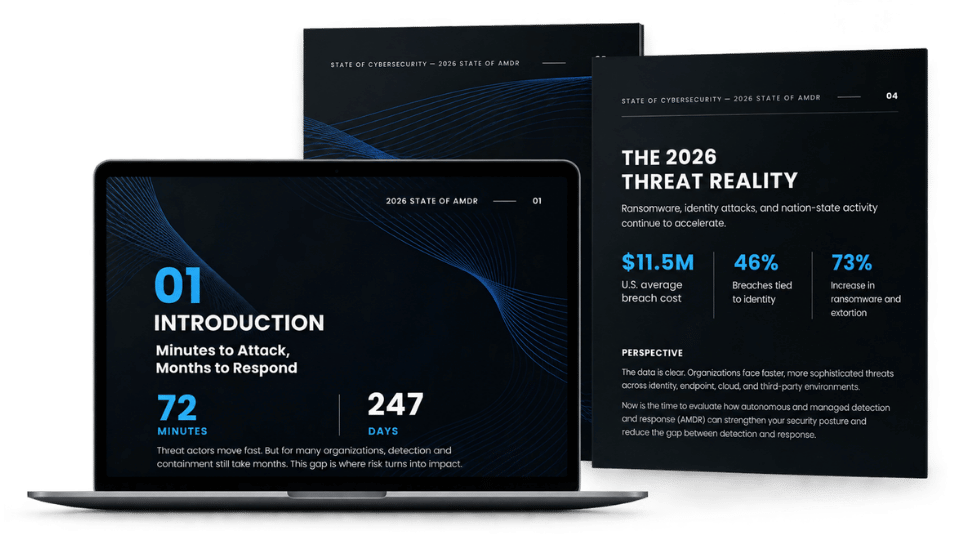
See how detection and response is changing now that attacks unfold in minutes, from the 95-day warning before ransomware to what separates real agentic MDR from repackaged tools. This guide defines the AMDR category and gives you the criteria to evaluate any vendor, ours included.
Get the Agentic MDR GuideFAQs
What is AMDR for Healthcare?
AMDR for Healthcare is a managed security service that uses AI agents to investigate and respond to alerts while human analysts oversee sensitive decisions involving clinical systems, patient data, and operational risk.
What does Agentic Managed Detection and Response monitor?
Agentic Managed Detection and Response can monitor available security information across identities, endpoints, email systems, cloud platforms, networks, and healthcare applications.
How is Agentic MDR different from traditional MDR?
Traditional MDR often relies heavily on analysts to review alerts individually. Agentic MDR uses AI agents to collect evidence, correlate activity, investigate alerts, and perform approved routine responses before escalating complex incidents.
Can Agentic MDR help detect healthcare ransomware?
Agentic MDR can help identify suspicious endpoint behavior, privilege escalation, credential misuse, unusual file activity, and lateral movement that may be associated with ransomware attacks.
Can healthcare organizations control automated response actions?
Yes. Response workflows can be aligned with organizational policies so routine actions are automated while sensitive decisions affecting clinical systems or patient care require human approval.
Does Agentic MDR replace an internal healthcare security team?
No. Agentic MDR Services extend internal capabilities through continuous monitoring, autonomous investigation, threat response, and access to experienced security analysts.